
Pepper spray effectiveness isn't determined by the formula alone. How that formula leaves the can,the spray pattern, has just as much to do with accuracy, range, and how it performs when it actually matters.
Whether you're carrying for everyday protection or professional duty, knowing the difference between stream, cone, fog, foam, and burst delivery will help you pick the right tool for where you'll use it.
Stream Pattern (8–15 Feet)
The stream is the most popular pattern for law enforcement and civilians alike, and for good reason. It sends a narrow, concentrated line of OC straight at the target. That means strong accuracy, very little airborne product, and far less chance of the wind carrying it back at you.
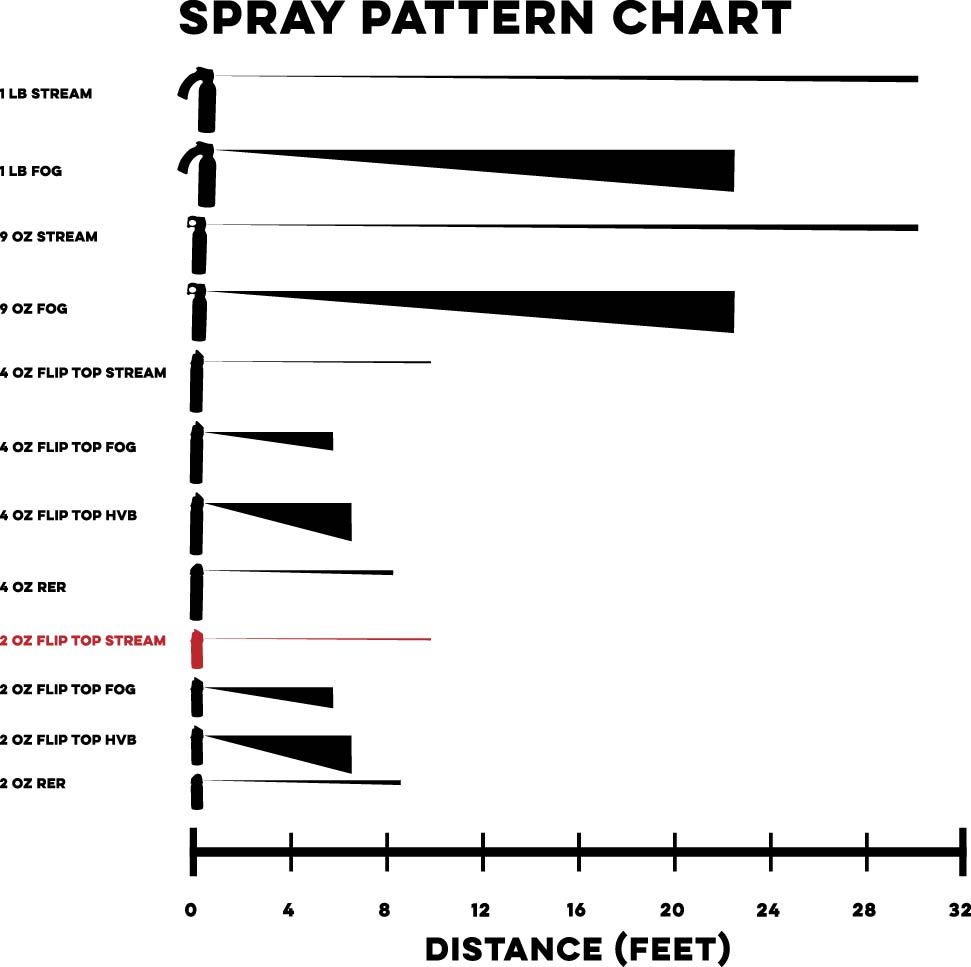 A stream gives you the longest effective range, holds up well in wind, reduces blowback, and conserves product by putting it where you aim. That makes it the right choice for outdoor use, vehicle carry, everyday concealed carry, and duty applications. Most 2 oz stream units deliver multiple one-second bursts with effective range between 8 and 15 feet — enough stand-off distance to give you room to react.
Cone Pattern (6–10 Feet)
A cone spreads the formula over a wider area, which makes it easier to land on a moving target or someone in close. The trade-off is range and wind resistance: a cone gives up distance and is more likely to drift or come back on you outdoors. It's a better fit for indoor security work, where wind isn't part of the equation.
Fog or Burst Pattern (10–15 Feet)
Fog and burst patterns put up a cloud of irritant that fills a space instead of hitting one point. That's what makes them useful for corrections, crowd management, and area denial — they cover ground, work against more than one threat, and are hard to get away from. They also carry real blowback risk outdoors and aren't suited to tight spaces without proper training. These are tools for specific jobs, and they should be deployed accordingly.
Foam (6–10 Feet)
Foam wraps the active ingredients in a thick coat that sticks to the target. There's almost nothing airborne, so cross-contamination stays low, and when the subject tries to wipe it off they only work the irritant deeper into their eyes. The trade-off is range and onset — foam needs direct facial contact and works slightly slower than a stream. It's a common choice for hospitals, detention facilities, schools, and correctional settings.
Why Distance Matters
Distance is one of the biggest advantages of carrying pepper spray at all. A quality 2 oz unit buys you reaction time and gives you the option to disengage and get to safety. As a rough guide: 3–6 feet is very close quarters with little time to react, 6–10 feet covers most civilian encounters, and 10–15 feet is the ideal stand-off range for stream and burst units. Wind, rain, and obstacles all affect what you'll actually get in the field.
Training Matters as Much as the Product
The best pepper spray in the world won't help if you can't deploy it under stress. Practice drawing the unit, releasing the safety, and presenting it toward the target. Inert training units let you rehearse the feel and pattern without the active ingredients, and regular practice does more for your confidence and reaction time than any spec on the label.
Choosing the Right 2 oz Pepper Spray
The right pattern is the one that fits where and how you'll carry. Stream gives you maximum range and precision. Cone gives you wider coverage up close. Burst and fog saturate an area for specialized work. Foam keeps deployment controlled with almost nothing in the air. Know the differences, match the pattern to your environment, and carry with confidence — because when seconds count, the right spray pattern can make all the difference.